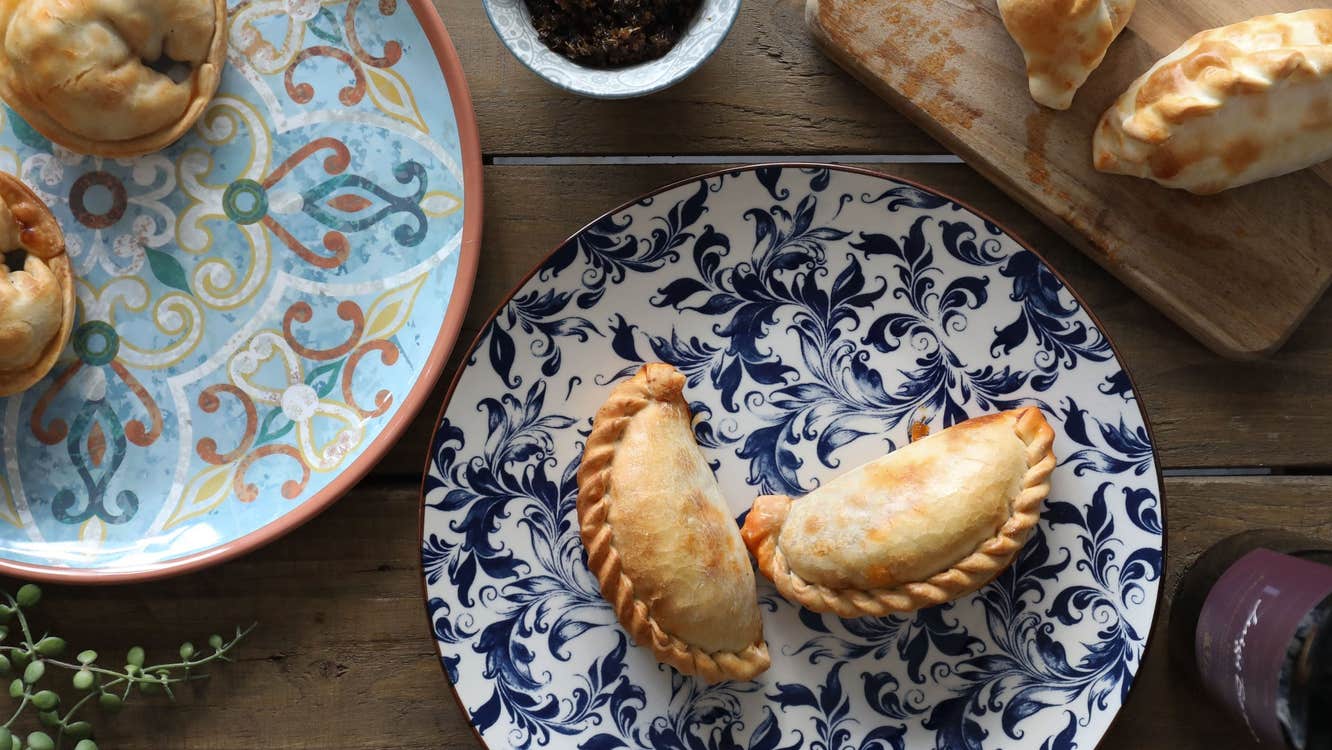
There are entire books about empanadas, and we love them so much that they even feature on the cover of this one. Pietro Sorba defined them as ‘embajadoras de identidad, cultura y tradición de cada territorio’ (ambassadors of identity, culture and tradition for each corner of the country) and we couldn’t agree more. Every region in Argentina (and across Latin America)has its own variations of empanadas, and it’s estimated that more than 10 million empanadas are consumed every day in Argentina, which has a population of 45 million people.
Filling
For the Egg Wash
Savoury Dough
Make the dough as per the recipe below, up to the point where you put it in the fridge to chill. Meanwhile, to hard-boil the eggs, put them in a medium saucepan and add enough cold water to cover them by about 1cm (1⁄2in). Bring the water to a boil, then reduce the heat to a simmer and cook for 8 minutes. Drain and cool them rapidly under cold running water before peeling and roughly chopping. (You can boil the eggs ahead of time and keep
them in the fridge, unpeeled.) Heat the oil in a large frying pan on a high heat. Once the oil is good and hot, add the onion – it should sizzle when you add it to the pan. Cook for 3 minutes, then add the sweet paprika, dried parsley, chilli flakes and cumin and cook for 30 seconds. Stir in the beef mince and tomatoes and season
with the salt and pepper. Break up the mince with the back of a wooden spoon and cook for about 15 minutes, until the beef is nicely browned.
Transfer the mixture to a bowl and allow to cool for about 15 minutes. Add the whole pitted olives and the chopped hard-boiled eggs. Cover the bowl with cling film and chill in the fridge for at least 1 hour (or for up to two days). It’s important that the mixture is chilled before filling the empanadas.
Preheat the oven to 200°C fan (400°F fan). Line two baking trays with non-stick baking paper.
Remove the dough from the fridge and use a rolling pin to roll it out until it’s 3mm (1/8 in) thick. Use a circular cutter with a 12cm (43⁄4in) diameter (or a similarly sized lid or the rim of a glass) to stamp out the dough – you should get 12–15 discs.
To fill the empanadas, put one disc in the palm of your hand and add a heaped spoonful of the filling to the middle. Be careful not to overfill or underfill it (you’ll notice the difference). Fold the dough in half and seal the edges, leaving at least a 5mm (1⁄4in) flat edge to avoid leaks. Crimp the dough together with the tines of a fork, then twist the edge to form a corkscrew shape – this technique is known as repulgue in Argentina. If you find this step difficult, you can just use the fork to press the flat edges together along the semicircular side. Put on the lined baking tray and repeat with the remaining discs and filling. For an optional golden finish, brush the tops with egg wash before baking.
Bake in the preheated oven for 15–20 minutes, until the empanadas are golden brown. Allow to cool slightly before serving.
For the Savoury Dough
Put all the ingredients in the bowl of a stand mixer fitted with the dough hook and mix together for 6 minutes on a low speed, until it all comes together into a smooth dough. Alternatively, to make the dough by hand, mix the salt into the water. Put the flour and paprika in a large bowl or on a clean work surface. Make a well in the middle and put the butter in the well. Slowly pour most of the warm water into the well and allow the butter to melt, then add the egg.
Mix the ingredients from the centre out until you form a uniform dough. You might not need to add all the water. If the dough feels too wet, add 1 tablespoon of flour at a time until it no longer sticks to your hands. Knead on a lightly floured surface until it comes together into a smooth dough – this could take 10–15 minutes.
Form the dough into a disc, wrap it in cling film and refrigerate it for at least 20 minutes or until you want to use it (it will keep for up to two days).
To make empanadas, use a rolling pin to roll out the dough until it’s 3mm (1/8 in) thick. Use a circular cutter with a 12cm (43⁄4in) diameter (or a similarly sized lid or the rim of a glass) to stamp out the dough – you should get 12–15 discs.